|
|
|
|
"But who is the enemy?"
Peter A. Taylor
February 19, 2026
Instead of reading this, consider listening to Benjamin Boyce's recent interview with Nick Land.
A Circular Firing Squad
There was a Robert Vaughn movie, The Bridge at Remagen, in which he plays a German officer in the closing days of WWII, who is wrongly executed by the German military at the end of the movie. As he is about to be shot, the officer hears airplanes overhead and asks, "Ours or theirs?" The firing squad leader says, "Enemy planes, sir." The last line of the movie is the officer musing, "But who is the enemy?"
I bring this up because of the head-scratching and circular firing squads I have been encountering both on the internet and in real life among the "dissident right". I use that term advisedly because some of the people I'm thinking of (e.g. Bret Weinstein) don't consider themselves "right wing", and the terms "left" and "right" don't seem to me to really have any consistent meaning. If you're standing at the North Pole, which direction is "south"? Some people talk of "the dissident sphere", but I don't want anyone thinking that I'm talking about the Symbionese Liberation Army. But whatever we call it, the dissident right has a problem with circular firing squads. If you're to the left of me, I denounce you as neutered false opposition. If you're to the right of me, I denounce you as an agent provocateur.
For example, Neema Parvini (Academic Agent) regards Jordan Peterson as an enemy. I regard both Peterson and Parvini as "friends", however flakey and unreliable they may be. James Lindsay and Konstantin Kisin are similarly controversial figures, not necessarily "right wing", and often denouncing and being denounced by dissident right figures who don't think they go far enough or don't share some critical point of doctrine. Lately, I am finding Peterson, Lindsay, and Kisin increasingly difficult to defend, but they have done some good work in the past, and I see no reason to throw out the good with the bad. They may be neutered false opposition, or even on the take, but they are also gateway drugs for Mencius Moldbug's red pill. They don't have to be infallible, or even reliable, in order to be useful.
In that interview linked at the top, Nick Land described neoreaction as "liberalism going through the five stages of grief". I think this describes me pretty well. Maybe a lot of this "neutered false opposition" (NFO) consists of other people who are going through different stages of the same process. If you regard me as NFO, please be patient.
Someone recently expressed surprise that there were any atheists (e.g. me) on a dissident right social media platform I recently joined. The dissident right, or at least the part of it I've been encountering lately on social media, seems to lean Catholic, but seems willing to accept most Protestants and Orthodox. Mormons are slightly outside the line, and atheists like me are viewed with surprise and suspicion, but they haven't booted me.
I'm comfortable calling myself a "neoreactionary", which is a subset of the dissident right, and roughly means someone who likes "Mencius Moldbug" (Curtis Yarvin's former pseudonym). Spandrell's "trichotemy" divided neoreactionaries into "religious traditionalists" (rel-trads), "ethno-nationalists" (eth-nats), and quasi-libertarian "techno-futurists" or "techno-capitalists" (techno-caps). In Nick Land's words, "Christian, Caucasian, and Capitalist". Think of the three-headed knight in Monty Python and the Holy Grail.
I think of myself as a busted libertarian, so I fit best in the techno-capitalist faction. My dissident right social media world is predominantly religious traditionalist (rel-trad). But people like Neema Parvini are not Christian, not Caucasian, and, judging by The Populist Delusion, not "Capitalist", at least in the sense of suffering libertarians gladly. There is also a strong element in the dissident right of what John Derbyshire called "a cold despair" regarding race relations, which has replaced the optimism about race which he and his peers felt in the 1960s. Since anti-white race hustling appears to be an integral part of what gives the Western political establishments their power and legitimacy, many white men on the dissident right tend to want to signal their defiance by expressing gratuitous hostility to other ethnic groups, which of course, alienates potential allies, feeds the establishment propaganda machine, and leads to suspicions within dissident groups that these defiance-signalers are lunatics and/or government provocateurs.
We desperately need a political Identification Friend or Foe (IFF) system.
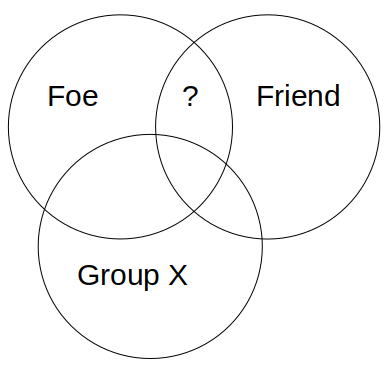
Part of what makes it difficult to avoid alienating potential allies is that, statistically speaking, membership in various religious, ethnic, or ideological groups really does correlate with attitudes towards the political establishment and its critics. I apologize for the fact that what I say will be US-centric, but I trust that most of it can easily be adapted to other Western countries. Jews, blacks, and atheists really do vote disproportionately for the Democratic Party and its allies. Furthermore, the US political establishment really does have a cozier relationship with the Democratic Party than with the Republican Party. But the correlations are weak enough that membership in these groups isn't a reliable proxy for being one of the enemy. The relevant Venn diagrams tend to look something like this:
Certain subjects are inherently statistical. I can't say that all men are taller than all women. I can't say that all women are taller than all men. I can't say that all men and all women are the same height. The best I can hope for is to be able to talk about averages and standard deviations.
Among atheists, people like Sam Harris probably outnumber people like Peter Boghossian, but if your dissident right IFF system identifies Boghossian as an enemy, your system is broken. Similarly, Jews like Jonathan Greenblatt and blacks like Barack Obama outnumber those like Brett Weinstein and Thomas Sowell, but if you think Weinstein and Sowell are enemies, or that Elizabeth Warren is your friend because she's white, your IFF system is broken.
I initially thought of "us" (Friend) as being roughly anyone who embraces the Anglo-Dutch "natural law" tradition. I think the word, "natural", here is something of a misnomer, so I would prefer to talk about the "traditional rights of an Englishman", but "natural law" is more likely to be commonly understood. Tom Holland's book, Dominion, ties Western civilization to "Christian moral assumptions", as opposed to what was considered "natural" in the ancient Roman world. I want to say "classical liberal", but the word, "liberal", has been too thoroughly corrupted. As Nick Land put it in "Psycho Politics",
"Liberalism" is the most profoundly corrupted word in political history. Without any exaggeration, rhetorical license, or metaphorical latitude, it's the leathery sliced-off face of something murdered long ago which now serves to disguise a foaming chainsaw-wielding maniac sharing none of its DNA.
In addition, I suspect that much of the "classical liberal" tradition was propaganda that was written in order to justify a series of power grabs that didn't necessarily have all that much to do with natural law (see Alrenous' "fossils of past power grabs").
I am also sympathetic to the adage that "The enemy of my enemy is my friend", so I am willing to make common cause with many people who don't adhere to the natural law tradition. The Objectivist Youtuber, TIK History, regards Keith Woods as a "fascist" over his "third way" socialism and ethno-nationalism, but from my perspective, that's just a variation on the "Hitler was a vegetarian" game. I am willing to work with both TIK History and Keith Woods. We have enough common enemies. As JGreenriver put it (on Discord), "Anyone against the regime, it doesn't matter if they are nationalists, libertarians, christians, pagans, realists, idealist or anything else, we're engaged in coalition-building."
But my Anglo-Dutch natural law definition of "friend" may be too narrow. A better test might be whether or not someone agrees that the US government is "Orwellian" in the Moldbuggian sense (Gentle Intro, pt. 1): "one whose principle of public legitimacy (Mosca's political formula, if you care) is contradicted by an accurate perception of reality." Or maybe friend or foe is simply about whether or not it's okay for the government to hate the people they govern.
The enemy (Foe) is basically the corrupt Western political establishment and its supporters, whom I regard as traitors to the natural law tradition. But as Bruce Yandle illustrated with his "Bootleggers and Baptists" paper, large political coalitions are full of factions with wildly different motivations and capabilities. Alcohol prohibition is supported both by high-minded Baptists who are trying to save the world from Demon Rum, and venal bootleggers who are trying to make money selling alcohol illegally. In terms of a "culture war", I will use Paul VanderKlay's term, "Progressive Liberationism" to describe the enemy, but this is an oversimplification as it treats corrupt actors (Yandle's "bootleggers") as if they were motivated by sincere quasi-religious belief. Other terms which are roughly equivalent to "Progressive Liberationism" are "Social Justice Warrior" (SJW) religion, "Woke" religion, "intersectional atheism", "The Blue Church" (Jordan Hall), and "gay race communism" (Curtis Yarvin).
The Culture War
As I see it, we are in a cold, fifth-generation civil war, i.e. one driven by information and deception. The conflict is built up in several layers.
The most obvious layer of conflict is racial. Some of this racial animousity is spontaneous and sincere. In fact, to some extent, it is ineradicable, because kin selection is part of the human condition. There is also the simple fact that different statistical populations are statistically different from one another. Pygmies will always be under-represented relative to Scandinavians in professional basketball; if basketball is an important part of the economy or the social status scene, this will always be a source of resentment. Also, I may regard Thomas Sowell as a "friend", but what about his grandchildren? Are they "likely cooperators" with respect to my grandchildren?
So a certain minimal level of racial friction seems unavoidable. However, outside of recent immigrant populations, most of the racial animosity that I encounter does not appear to me to be spontaneous, but instead appears to be artificially stimulated, the result of deliberate cultivation by professional race hustlers. As I see it, Hamilton's rule (kin altruism) acts as a pilot light for racial conflict, but the real problem is the race hustlers who pour gasoline on the fire. Recent immigrants tend to bring their racial grudges with them.
As Reihan Salam argued in The Atlantic, much of "white-bashing" is a false cover for socio-economic class conflict, in which Salam's "upper whites" punch down at the "lower whites" while pretending to punch up on behalf of the "oppressed". White-bashing is also helpful in driving voter turnout among blacks, et al, who vote overwhelmingly for the Democratic Party (not that there's all that much difference between the Democratic Party establishment and the Republican Party establishment).
Louise Perry thinks the British government's behavior regarding the Rotherham "grooming gang" scandal is largely a result of class snobbery.
It's not clear to me whether class conflict in the US is best looked at in terms of "upper whites" vs. "lower whites", the managerial class vs. the working class, or organized crime. There is also Bertram de Jouvenal's three-tiered model of class conflict, in which the high and the low combine against the middle.
But the overwhelming majority of the people I identify as "foe" are neither sincere, spontaneous haters of white people nor deliberate cultivators of racial animus. Most of them are adherents to the quasi-religion I am calling Progressive Liberationism. Progressive Liberationism appears to me to be the de facto state religion throughout the Western world, and is in a cold war against the previous de facto state religions, which in the US used to be Protestantism, in conjunction with some ancestor worship for the Founding Fathers, which is known as "civic religion".
It can be hard to disentangle racial conflict from religious conflict because Progressive Liberationism is largely a religion about racial conflict, but when physically white people denounce liturgically white people as having something akin to original sin, you're dealing with quasi-religion. (Thomas Sowell seems to be liturgically "white".)
It can also be hard to separate class conflict from religious conflict. The "upper whites" Salam describes, and people who cosplay as upper white, are sometimes ridiculed in terms of "Stuff White People Like" (SWPL). The only payoff that someone like my wife gets for supporting SWPL is a warm feeling and some social acceptance from her female peer group, or what the IRS calls "intangible religious benefits". I find it hard to distinguish between the "group-fostered beliefs" of religion and group-fostered affectations of good taste.
Conflict over a de facto state religion also seems inevitable. By "de facto", I mean not merely "religions" that are narrowly defined as having to do with supernatural beings, but also other examples of the functionally similar systems that David Sloan Wilson called "unifying systems", such as political ideologies and patriotic distortions of history. Gaetano Mosca argued that all governments have doctrines about their own moral legitimacy, and called such doctrines "political formulas". But modern "axial age" religions such as Christianity are impossible to separate from moral teachings. The same is true of "unifying systems" in general. So what's the difference between a "political formula" and a de facto state religion?
The quasi-religious grouping VanderKlay refers to as "Progressive Liberationism", Joseph Bottum refers to as "post-Protestant" in his book, An Anxious Age. Bottum writes,
In their moral and spiritual certainty, the post-Protestants captured the credentialing machinery of American culture as a class fiefdom—and formed a new class that rent-seeks, hoards privilege, self-righteously congratulates itself, and arrogantly despises other classes as thoroughly as any group in American history ever has.
There is also a layer of conflict that is simply corruption. As Neil Oliver put it, sometime in the last hundred years, all of the Western governments, corporations, and organized crime became fused. The result is that, in George Carlin's words, "It's a big club, and you ain't in it."
This "corruption" could include a fair bit of enemy action, i.e. bribery or blackmail by China or other foreign governments. We know about Jeffrey Epstein and the general corruption of Western intelligence and law enforcement agencies, but we don't know to what extent various non-Western agencies are engaged in similar shenanigans.
Megan McArdle had an article in The Atlantic some years ago about bankruptcy law, in which she argued that, rather than thinking about bankruptcy law in terms of creditors vs. debtors, it was often more helpful to think of it in terms of insiders vs. outsiders. Insider debtors realize that they are going bankrupt, so they cut a deal with insider creditors. The insider creditors get paid in full, then the company declares bankruptcy. The outsider creditors are given an empty sack, the outsider debtors get nothing, and the insider debtors get kickbacks under the table. Similarly, rather than thinking about politics in terms of "left" vs. "right", or Democrat vs. Republican, it may be more helpful to look at politics in terms of insiders vs. outsiders. Are the Republican Party base and the Bernie bros on opposite sides (right vs. left) or the same side (outsiders)?
Immigration policy is driven to a considerable extent by the desire on the part of the wealthy insiders to reduce labor costs. Yandle's "bootleggers" are often large corporations (insiders) using the government to suppress competition, e.g. in the lawnmower business, exploiting consumer safety "Baptists" in order to increase the overhead disproportionately on their smaller competitors (outsiders). The behavior of real estate prices seems to be driven in large part by government policies for the benefit of wealthy insiders. Political insiders manipulate voters in the name of helping the poor and downtrodden into supporting things that are good for rich insiders.
Some racial conflict in the modern US may be spontaneous, or "bottom up", but the lion's share appears to me to be pushed "top-down" by agitators motivated by money and power, as David Reich describes. Some journalism appears to be motivated by genuine class snobbery, as Reihan Salam suggests, but as Josh Neal says, modern news outlets tend to be "loss leaders" whose job is to manipulate public opinion on behalf of some patron rather than to turn a profit on their subscription fees and advertisement revenue. (A dishonest newspaper is thus more valuable to its owner than an honest one.) Some of the impetus for open borders may be sincerely quasi-religious, and some small part serves wealthy financial interests, but it appears to me to be mostly the result of politicians trying to exploit the Curley effect. The replacement of mainline Protestant Christianity by Progressive Liberationism, and the direction in which Progressive Liberationism has developed, similarly appears to me to be the result of a mixture of spontaneous bottom-up religious behavior and top-down manipulation by various elites (including, apparently, USAID; see also ADRA, APNews, and Blaze TV).
Blamblas Britannica offers a more cynical alternative to the Curley effect as a motive for elite importation of hostile ethnic minorities. Rather than trying to import loyal client groups, the elites may simply be trying to prevent the lower classes from being able to unite against the oligarchs, importing incompatibility for incompatibility's sake. As John Milton put it,
Chaos umpire sits,
And by decision more imbroils the fray
By which he reigns
It's hard to tell the difference between a True Believer and an opportunist. It's also hard for me, as a layman, to tell the difference between a sociopath and a person who is just really good at self-deception. Humans have a tremendous capacity for believing their own bullshit, so these two things tend to blend together. How much of the problem is Ed Dutton's "spiteful mutants"? Something about this world feels like an H. P. Lovecraft story, or "demonic" as a Christian might say. As an atheist, I feel like I need a better theory of evil.
I don't have an org chart for George Carlin's "big club". I'm also not sure what to call them. "Bootleggers"? "Oligarchs"? Henry Sumner Maine used the term, "wire pullers". Political scientist Chandler Davidson wrote in Race and Class in Texas Politics that the wealthy "Bourbons" who dominate Texas politics don't act cohesively enough to be properly called a "ruling class", so I will probably call them "oligarchs". I expect arguments within the dissident right about how cohesive the oligarchs are, and whether or not it makes sense to try to play the various factions off against one another.
There is also a layer of intergenerational conflict. Social Security and Medicare, for example, are basically forced Ponzi schemes that transfer huge amounts of money from the young to the old, with insolvency rapidly approaching. Social Security has long been the "third rail" of American politics (refering to the electrified rail of a street trolley). John Papola says similar things about the US government's manipulations of the home mortgage market. The complaints about these transfers, and the fierceness with which the elderly defend them at the ballot box, are legitimate. Young people often joke about suffocating the "baby boomers" (i.e. The Day of the Pillow) for these financial crimes and for generally being horrible stewards over what was once a much more highly functional US government. But in many cases (e.g. open borders), the Boomers are largely innocent of having voted for these changes. Much of what is wrong with the US government is largely a reflection of principal-agent problems.
The Trichotemy: Religion
The differences of opinion within the trichotemy are largely a reflection of differences of opinion about which layer of social conflict is most important, which is largely a reflection of differences of opinion about what it is that binds a nation together. According to Wikipedia, "Dunbar's number is a suggested cognitive limit to the number of people with whom one can maintain stable social relationships...." Robin Dunbar estimates his number to be 150. But the population of the US is about 350 million, more than six orders of magnitude greater. What kind of sociological glue can hold together a nation of this size? Eth-nats think a nation is best bound together by blood, and tend to take the racial drama in the US at face value. Rel-trads think a nation is best bound together by religion, and tend to see religious conflict as primary. Techno-caps tend to either be technological or historical determinists, or to think that a nation is best bound together by enlightened self-interest and a cleverly written constitution.
The trichotemy has been compared to a three-legged stool, with all three legs being essential to keeping the stool upright. That is, it has been argued that no one or even two methods of binding a nation together are enough. We may need ethnic solidarity and a good state religion and a good constitution. It's also possible that even all three are not enough.
As a spergy, "busted libertarian", compulsive system builder, I don't mind talking about constitutional changes, but I'm pretty disillusioned about it. What's the point of a good constitution if the country is being run by a bunch of sociopaths who won't follow it? I don't know how to deal with sociopaths other than by making quasi-religious appeals to voters and government employees not to support them and not to buy into the Cathedral's quasi-religious propaganda. I'm reluctant to talk about race because (1) I don't want to feed the establishment propaganda machine and (2) in the short run, there isn't much I can do about it. I can't persuade people to change their genes. About all I can do about race is try to argue for closing the borders. Even then, the issue is more directly about culture, ideology, religion, and coalition membership than genetics. I want to focus on religion because it's the thing I can do something about, i.e. persuade people to change their beliefs. Furthermore, in so far as I do want to talk about race, I have to address religion anyway because Progressive Liberationism is largely a religion about race. So I mostly want to support the rel-trad leg of the trichotemy.
This is a problem for me because I'm not a Christian, and the religious tradition Western civilization relies on is Christianity. See Tom Holland's Dominion. This is also something of a sore point among the rel-trads. Conservative Christians are fighting a civil war within Christianity against Progressive entryists, and I can't really get close to them without getting caught in the crossfire. They are also fighting an external war against Christopher Hitchens-style "hot" atheists, and I, as a "cold" atheist, just look to them like yet another false friend or a concern troll. Jonathan Pageau says "cultural Christianity" means "Antichrist" at about the 1:16:03 mark in this Paul VanderKlay video, so I am at best Antichrist-adjacent in Pageau's view.
I want the religious envelope of the dissident right to be large enough to accomodate me, but not large enough to accomodate most of the NPR-listening people at my Unitarian Universalist church. I also want the rel-trads to be on friendly terms with many of the Neopagans (e.g. Hearthfire Radio, see Millenniyule X), i.e. to accept them as "clubbable". I think the key points about religion here are:
A "clubbable" religion needs to repudiate "telescopic altruism". See Bishop Fulton Sheen on false compassion. Moral obligations are lumpy. I have moral obligations to family, friends, and fellow countrymen above and beyond any that I might have to 10-foot-tall blue space creatures (hat tip: Steve Sailer).
A "clubbable" religion needs a source of moral leadership that is independent of politicians and the intellectual fashion industry (AKA The Cathedral). As the Christians say, "Render unto Caesar that which is Caesar's and render unto God that which is God's."
A "clubbable" religion has to hold its members to at least as high a set of moral standards as it holds non-members, and it has to be honest about what those standards are.
A "clubbable" religion (or culture!) has to repudiate racial double standards. This may or may not exclude certain kinds of Pagans and Jews. It's okay to be ethnocentric, but it's not okay to have double standards about it.
The Trichotemy: Ethnicity
Eth-nats also tend to regard many other dissidents as entryists, false friends, or concern trolls for being outside of some envelope of opinion. This envelope is defined over a number of different spectra:
One such spectrum is the depth of the "cold despair" that John Derbyshire mentioned. Is racial harmony between whites and significant numbers of non-whites inherently impossible, is it possible only in societies that are non-democratic enough to jail race hustlers, or is it possible in a democracy as long as the dominant religion condemns race hustling? Do you trust Neema Parvini? Would you trust ten million Neema Parvinis? (There are "peer effects": small minorities are likely to behave differently if their numbers increase and they become large minorities or majorities.) This "cold despair" affects people's attitudes towards freedom of association. Derbyshire said in the interview noted above that what happened in the 1960s was that we gave up freedom of association in exchange for promises of racial harmony. If those promises had been kept, would that have been a good bargain? Is it even possible that they could have been kept?
A second spectrum is attitudes towards free speech. Part of the disagreement has to do with the effectiveness of offensive rhetoric. I may think that you should be free under both criminal and civil law to say offensive things, but simultaneously want to kick you out of my social or political organization for having bad etiquette or bad message discipline, even though I sympathize with the temptation to violate speech taboos that involve double standards. I sympathize with Eric Weinstein's comments on this Triggernometry interview (around 49:47, in the context of internet anonymity). There need to be some adults in the room who can tell the children to behave. I also liked this exchange between Jared Taylor and Millennial Woes from Millenniyule X (1:11:24):
Jared Taylor: Sometimes I do work up a head of steam and I will write something or I will say something and I will look back later and I will cringe because it's something that is excessively harsh or sounds mean-spirited. And that's not the way to get across to people whose minds must be changed. My attitude has always been there'll be no solutions unless there are more people who agree with us. And so, how do you approach them in a way that will persuade them to agree with us? And that means you have to speak in ways that normies will find acceptable and persuasive. I don't always succeed, but that's my goal.
Millennial Woes: At any rate, I don't think anything is gained from speaking in unpleasant ways. And aggressive, angry ways. Because it doesn't get the normies but I don't think it gets anyone else, except people who are maladjusted.
On the other hand, we have the example of Nick Fuentes. I've been trying to get one of my dissident right friends to tone down his rhetoric, but after thinking about Fuentes, I'm starting to think that I owe my friend an apology. Maybe there's a place for a good cop/bad cop game, and I'm just the wrong temperament to play the bad cop.
A major problem we have, at least in the US, is that there is a massive character assassination industry that intimidates people who want to criticize The Powers That Be (TPTB). But the intimidation only works so long as the normies mostly go along with it. What Fuentes seems to be doing (with some help from the Gaza war and the festering Jeffrey Epstein scandal) is triggering a "preference cascade". Think of the death of Nicolae Ceausescu.
Alternately, you can think of Fuentes as taking a sledgehammer to the Overton window. What was unspeakable is now speakable. I want to criticize Fuentes for bad etiquette, but if he had good etiquette, would he still be as effective?
There are other areas of disagreement regarding freedom of speech, but they are less salient.
A third spectrum is, "What is the right level of ethnocentrism?" To perhaps oversimplify, we could define a scale of 1-10, where "1" is a cuckold* and "10" is a "Nazi" in the sense of someone advocating genocide for reasons that don't make sense. One might well ask, where are La Raza, the ADL, and the KKK on such a scale? If I love my children, but my children have white skin, does that make me a "Nazi"? An intelligent conversation about ethnocentrism would have to distinguish among calls for (A) better border control, (B) freedom of association, (C) ethnic cleansing (locally or nationally), and (D) genocide. Where is the "reasonable" range on such a scale? People like Konstantin Kisin seem to take Progressive Liberationist propaganda about Whitey being on the cusp of turning into a "Nazi" way too seriously. It's hard to say how much of the conflict such people have with the dissident right is over substance and how much of it is over labeling.
*Or perhaps someone like the son, Andriy, from the movie Taras Bulba, a Cossack who falls in love with a Polish princess and switches sides in a war between the two nations.
A fourth eth-nat spectrum of opinion is, "How far back in time do we go in questioning the moral legitimacy of a government's past immigration policies (i.e. importing electoral mercenaries)?" The 1990s? The 1960s? The 1920s? 1776?
Finally, there is a range of opinion on how best to deal with practitioners of racial identity politics, i.e. "race hustlers". I want to use a World War I analogy: if you are a member of the French general staff, and you have just been informed that the Germans have started using gas warfare, how would you want to respond? One possibility is for the Allies to embrace gas warfare enthusiastically. A second possibility is to threaten gas warfare in return, and possibly engage in it reluctantly, while trying to negotiate a ban on gas warfare. A third possibility is unilateral disarmament with respect to gas warfare, giving the enemy an asymmetrical advantage.
One might want to reject Jordan Peterson as a friend of the dissident right, despite his position on free speech and his willingness to discuss race and IQ openly, simply because his posture of unilateral disarmament regarding identity politics seems like an incompetent bargaining strategy†. The obvious counterargument is that race hustlers as a group are not agreement capable. There is no Kaiser of race hustling who can enforce discipline on his army. I'm reminded of the statement by Nyan_sandwich that "The difference between a reactionary and a conservative is that a conservative thinks you can negotiate with Cthulhu." You can't negotiate with race hustlers as a group. It's like trying to negotiate with an ecological niche. The gas warfare analogy doesn't work.
†Jeremy MacKenzie, in his Millenniyule X interview, was highly critical of Peterson. My thinking here is that: (1) Peterson never really recovered from his benzodiazepine fiasco. (2) MacKenzie may have a point about Peterson being too focused on money recently. (3) Peterson's inability to give a straight answer to questions about his theological beliefs reminds me of David Sloan Wilson's distinction in Darwin's Cathedral: Evolution, Religion, and the Nature of Society between "factual realism" and "practical realism". Christianity, and perhaps religion in general, seems to require a certain amount of doublethink on the part of its leaders. It has a sort of Schrödinger's cat vibe, which I write about here. You have to "get the joke" while simultaneously "not getting the joke". This problem seems to have broken Peterson's brain. Or maybe he just can't face the consequences of telling Virginia that Santa Claus isn't real. (4) Different people have different budgets for risk. How many hornets' nests are you willing to whack with a stick, and which ones? If someone else has a lower risk budget than I do, does that make him an enemy asset? What if his "engagement queue" (targeting priority list) is different than mine? Overall, I'd say that Peterson has way bigger balls than I do, so I don't feel like I'm in a position to criticize him. I like a lot of his lectures. My overall conclusion regarding Peterson is to follow my mother's general advice regarding church attendance: Eat the chicken and leave the bones.
One way of dealing with race hustlers is to accept some restrictions on free speech, making Western countries less democratic: make race hustling illegal and prosecute it. This might also involve a formal state religion, with "an Archbishop and Grand Inquisitor" per James A. Donald, tasked largely with prosecuting race hustlers. One alternative to legal prosecution might be a more traditionally religious "Great Awakening" that is so successful that it would make race hustling unprofitable outside of small niche markets. Perhaps it is only dominant factions among the Western oligarchies that need to "put the Woke away", i.e. stop mandating and subsidizing Woke. Perhaps this "Great Awakening" only needs to be successful enough to make race hustling unprofitable for the dominant political elites. This is what I think Jordan Peterson is trying to do. My interpretation of Peterson is that he is saying, correctly, that while telling the truth about racial conflict is good, white identity politics is playing into the Woke narrative. Whether it succeeds or fails, white identity politics leads us away from freedom of association and meritocracy.‡ Some people may think this is a good tradeoff, a necessary evil, but other good faith members of the dissident right disagree, and think, as I do, that race realism needs to be presented with extreme delicacy. What we are doing here is not dispensing cluster munitions, but trying to build an IFF system. In doing so, in my opinion, we need to bear in mind that the enemy is not people like Thomas Sowell, but people like Elizabeth Warren.
‡I'm not pushing meritocracy to the exclusion of kin altruism. Part of what it means to be human is to participate in "multi-level selection" (see D. S. Wilson): to be a member of multiple teams both cooperating and competing with multiple other teams simultaneously on multiple levels. The object is to strike an appropriate balance between meritocracy and kin altruism. Ideally, one should be able to be honest about this safely, and to insist that others be honest about it as well. One has to be prepared to recognize and deal with principal-agent problems in which an agent pretends to be acting meritocratically (e.g. in the interests of the company that hired him), but is actually sacrificing the principal's interest for the sake of his kin group and possibly creating a hostile "ethnic mafia" within the organization.
I think the key points about ethnicity that the dissident right should agree on are:
Immigration needs to be severely restricted until we agree on how to vet would-be immigrants and who can be trusted to do the vetting (or when Hell freezes over, whichever comes first).
In a democracy, as far as the government is concerned, freedom of political speech has to be non-negotiable. Exceptions (e.g. incitement to riot, libel, and possibly race hustling) need to be very carefully delineated. (I may have to walk this back a bit, e.g. to require reciprocity. Hat tip: Blamblas Britannica.)
Racial McCarthyism has to end.
Racial double standards in general have to end.
The "disparate impact" doctrine is bullshit.
Race-based witchcraft accusations (e.g. "stereotype threat") have to end.
The "protected classes" in US civil rights law are incompatible with the 14th Amendment, and must be rejected.
Dual citizenship must be abolished.
The Trichotemy: Capitalism
There doesn't seem to be as much conflict as I would have expected between the eth-nats, who are often socialists, and the quasi-libertarians like me. This is partly because economic theory seems unimportant in the face of the corruption and insanity of the modern Western world, and partly because we busted libertarians only arrived at neoreaction after we realized that ideologues like Bryan Caplan and the Libertarian Party leadership were insane. Still, there are some points of potential conflict.
There is a spectrum of opinion about how seriously to take economic theory. There is another spectrum of skepticism toward using government to perform charitable functions. There is another spectrum of freedom vs. resisting degeneracy. Another, closely related spectrum is how much are you into individualism vs. family and community. To what extent do you have to dance with them that brung you? There is also a spectrum of opinion regarding how black-pilled to be about democracy. Monarchism is on the table, but there isn't a consensus behind it.
I think we should be able to agree on the following:
Concerns about defense, distribution of wealth, and resilience severely limit how seriously we can entertain the "economic efficiency" arguments for free trade. But the devil's in the details. Even Bryan Caplan is right occasionally.
Governments tend to be more efficient in ethnically homogenous societies, but they still tend to be very blunt instruments when it comes to doing charity work, and highly prone to corruption.
Bayescraft
The heart of the IFF system I think we need is what Eliezer Yudkowsky calls "Bayescraft". (See my Industrial Engineering Dharma Talk #2.) In Decision Theory, there are distinctions between deterministic decision making (where you're not gambling), decision making under risk (where you're gambling, but you know the odds), and decision making under uncertainty (where you're gambling, but you don't know the odds). As I recall, Yudkowsky regards "deterministic" and "uncertainty" as special cases of "risk". Bayescraft is about calculating the odds. This is sensitive to how much information you have. If all I know about someone is that he's a military age Chinese man entering the US illegally, I'm going to guess that there's an unacceptably high probability (as a placeholder, I'll say 90%) that he's a bad actor (e.g. spy, saboteur, or other type of Chinese special forces). This is my "initial probability", or "Bayesian prior probability". If I get other information, I will want to combine it with my prior probability using Bayes' formula. In practice, people normally perform this sort of reasoning as informal guesswork rather than by plugging numbers into a computer, but the principle is the same. If the Chinese man marries a German woman in Fredricksburg, Texas, gets a job as a haberdasher, converts to Catholicism, and raises a family, I'll lower my probability estimate that he's a spy to 30%.
If I encounter a random black American voter at the Department of Motor Vehicles office, I will guess that there is close to a 95% chance that he votes for the Democratic Party. But if I find out that he is an avid reader of Thomas Sowell and attends a conservative church regularly, I will move him into the "likely cooperator" category.
Note that the amount of information that you are likely to have, and that you have the time, means and motive to aquire, is very different depending on whether you are (1) an immigration officer thinking about a sketchy asylum seeker or (2) if you are thinking of proposing marriage to someone. Naill Ferguson did not marry a random Somali immigrant; he married Ayaan Hirsi Ali.
If I want to know if someone is a "likely cooperator", then it may also be important to know what the project is, on which I want him to cooperate with me. Walt Bismarck expressed the correct attitude towards the end of his interview on Millenniyule X (1:55:35).
We don't have to agree 100% of the time. We agree 60% of the time and then we can use each other to advance directionally where appropriate. I think poltics is coalitional and transactional. The idea that you need to be 100% aligned on all things in order to have a productive alliance is ludicrous. At the end of the day, you need to be pragmatic and make alliances where you can.
In the US, gay men tend to vote for the Democratic Party. Christians have historically regarded homosexuality as a sin, and the Catholic Church is notorious for having problems with a "lavender mafia" of priests who are...sexually eccentric. But there are also the "log cabin Republicans". When is it appropriate to work with gay men?
Someone on a dissident right social media platform recently complained that the German Alternative für Deutschland (AfD) political party was actively seeking to attract homosexual voters. The advertisement reads:
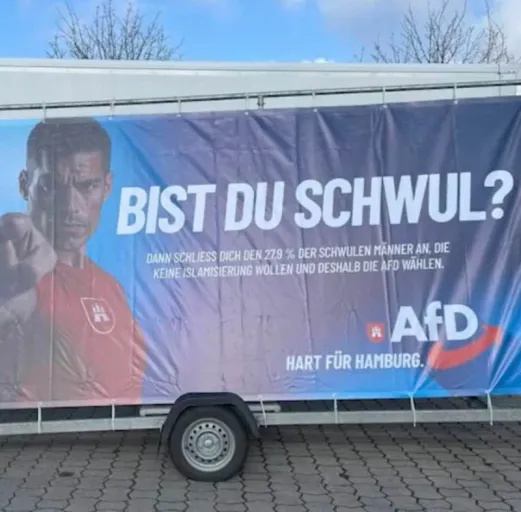
Bist du schwul? Dann schliess dich den 27,9% der schwulen Männer an, die keine Islamisierung wollen und deshalb die AfD wählen. AfD. Hart für Hamburg.
Are you gay? Then join the 27.9% of gay men who do not want Islamization and therefore vote for the AfD. AfD. Hard for Hamburg.
I can imagine a number of circumstances in which refusing to cooperate with gays might make sense. Certain religious groups will have religious reasons for ostracizing gays. Other groups will regard homosexuality, at least in part, as a social contagion, and will want to avoid allowing their children to socialize with gays. I can imagine Pope Francis deciding that there was either (A) an unacceptably high probability of a gay man turning out to be a bad priest or (B) too high a proportion of gay men in the priesthood already and that the "peer effects" of additional gay priests were unacceptable. I can even imagine a power struggle within the AfD in which one faction is afraid that too high a proportion of gay and lesbian party officials will lead to a "lavender mafia" taking over the party and diverting it from its original purposes. But under the circumstances, condemning the AfD for trying to garner gay men's votes in order to oppose further Muslim immigration does not make sense. The AfD's purpose is largely to aquire political power in order to oppose Muslim immigration. For purposes of this project, the only way that gay men at the level of retail voters are going to harm the AfD is by voting for someone else, such as Die Linke.
It seems to me that the least friendly attitude that would be appropriate for members of the dissident right to take towards gay AfD voters, even among the religious traditionalists, is the one Winston Churchill took toward the Soviet Union when it was invaded by Nazi Germany:
If Hitler invaded hell I would make at least a favourable reference to the devil in the House of Commons.
I am reminded of a comment by Maurice Duverger in his book, Political Parties, that there were two kinds of political activists: There is one kind whose motto is "Fight to win" and another kind whose motto is "Fight to feel good about losing." As a "busted Libertarian", I am very familiar with the latter kind of political activist. I would very much like the dissident right to avoid emulating the Libertarian Party in this respect.
I had intended to write a couple of appendices to this essay, but a year has gone by, and the end is nowhere in sight. This is it for now.
|
|
|
|